

AI is everywhere. Google’s search results look different every month, ChatGPT can supposedly write content for you, and many business wonders are wondering if traditional SEO even matters anymore.
The short answer: Yes, SEO is absolutely still worth it — but a few things have changed.
We’ll cover what’s changed, what hasn’t, and when SEO makes financial sense for your Indiana business. We’ll dig into AI’s actual role in search, whether you can DIY it with ChatGPT, what GEO means for your strategy, and the techniques that make SEO more valuable than ever.
The Elephant in the Room: Is AI Killing SEO?
The short answer: No. Here’s why.
Large language models — ChatGPT, Claude, Perplexity, and others — are not directly replacing search, they’re summarizing it through a process known as grounding. Essentially, grounding is when an LLM realizes your question is outside the scope of its training data, and it seeks more information via search engines before answering.
So if you’re not ranking in traditional search, you’re likely invisible to AI tools too. Think about it: if your website sits on page 10 of Google, AI is probably not going to surface your content in its answers. AI tools prioritize the same high-ranking, authoritative sources that Google does.
Also, keep in mind that Google still owns the vast majority of search traffic. Traditional search still accounts for 40% of web traffic, while all AI agents combined account for less than 1%. While this may change in the future, for now, traditional search is still far ahead of AI.
So How is AI Changing Search?
While search engines still hold the lion’s share of traffic, it’s fair to say that AI has influenced how people are searching.
Here’s what you should know about search in 2026:
- AI queries are more conversational and question-based. Instead of typing something like “plumber Lafayette Indiana,” people ask AI questions like “who’s the best plumber near me for emergency repairs?” This means content on your site should also be more conversational and cover topics thoroughly, rather than simply targeting keywords.
- Featured snippets and AI Overviews matter more than ever. Google’s AI-generated summaries appear at the top of search results for many queries. If your content answers questions clearly and concisely, you can appear in these prime positions.
- The top 3 search results also matter more. With AI Overviews taking up screen space, organic results below position 3 get even less attention. Just ranking on page 1 isn’t enough anymore — you really need to be in the top 3.
- The fundamentals haven’t changed. SEO in 2026 still relies on solid fundamentals that have been used for years. The difference is adapting to how people search, and how AI tools surface information.
Tip: If you want to learn more about AEO and SEO and how to adjust your strategy, check out our guide on how to integrate AEO with traditional SEO strategies.
Should I Use AI to Save Money on SEO?
Our honest take: AI is a tool, not a replacement for strategy. AI is a powerful tool, but like they say, make sure you’re using the right tool for the job.
What you can safely use AI for:
- Generating content outlines. AI is great at structuring topics and identifying subtopics to cover, as well as helping you think of different use cases and questions your ideal customers might have.
- Brainstorm keyword ideas. AI can suggest related search terms and even dig up keywords you might not have thought of, but these still need human vetting to match search intent.
- Analyze data patterns. It can spot trends in analytics data when given the right prompts and access to your data. Just be sure to check its work; AI is known to fabricate information even when given data to work from.
What AI can’t do (unless you want to tank your SEO):
- Decipher how your business goals tie into SEO strategy. AI doesn’t know that you make more money from commercial clients than residential, or that certain keywords attract tire-kickers. More importantly, AI is known to make things up, so you can’t rely on it for accurate data.
- Make strategic decisions about site architecture. Should you split one service page into three? Combine regional pages? These decisions require understanding your business priorities, not just search volume.
- Understand how one change affects your entire site. AI looks at your website through a soda straw and often makes recommendations based on one data point. It may ignore what a change will mean for your whole site architecture, user experience, or brand positioning.
- Understand local market nuances. Should you target Greater Lafayette as one market or split Tippecanoe County into sub-regions? And do you need to focus on the same service offering in each area, or different ones? AI won’t know your local market the same way an Indiana-based marketing team does.
- Implement technical fixes. SEO is more than just content writing — it’s a strategy that covers everything about your website. A good SEO strategy still needs someone who can set up redirects, fix broken links, optimize page speed, and other technical fixes.
Our Approach to Using AI in SEO
We believe strategy decisions are made by people, not algorithms.
While we may use AI for outlining and brainstorming, every piece of content is written by humans who understand both SEO and your business. We never publish AI content, because we believe your business deserves the best.
The Problem with AI-Generated SEO Content
We’ve covered why you shouldn’t use AI in your SEO strategy, but we felt it necessary to dig more into why you should reconsider using AI to write content for your website.
You might hear people say that Google can detect AI-generated content and won’t rank it. The truth is, there’s a little more nuance to the situation. Here is what Google has to say about using AI content:
Should I use AI to generate content?
If you see AI as an essential way to help you produce content that is helpful and original, it might be useful to consider. If you see AI as an inexpensive, easy way to game search engine rankings, then no. (Source: Google)
So Google can recognize AI content, but it will not automatically penalize you for using it. What you will be penalized for is low-quality content, whether AI writes it or not. This is the same thing they’ve been doing for years — nothing has changed in that regard.
At the end of the day, whether you use AI to write content or not comes down to the reason you would hire a marketing agency in the first place: you want an expert. If you know what high-quality content is and have the time to produce it, you don’t need someone to write it for you — but you also don’t need AI.
But if you don’t have the time or expertise to create content yourself, consider who you’re trusting your business with before you use AI.
When Does SEO Make Sense for Your Business?
While SEO is one of the most profitable marketing channels out there, not every business is ready for it. Here’s when it makes sense — and when it doesn’t.
When to use SEO:
- You’re doing $2M+ annually and can afford a longer timeline. SEO can take 6-12 months to show results, so you have to weather that ramp-up period without worrying about your budget.
- You want to future-proof your lead generation. Paid ads are great for specific things like a product launch or event, but once you stop paying for them, you stop getting leads. SEO builds equity that stays on your website for the long haul, even if you discontinue services.
- You’re building a secure future for your business. SEO is for companies thinking in years, not quarters. Other marketing channels rely on platforms you don’t own, such as social media or paid ads. SEO invests in your website and creates assets you can continue to repurpose in the future.
- Your competitors are investing in it. Not doing SEO means giving revenue to your competitors who are. Stop letting them win and start showing up at the top of search for your top offerings.
When SEO might not be the best fit:
- You need new leads now. SEO takes 6-12 months to generate meaningful results. If your business needs immediate leads, you might consider starting with paid ads instead.
- Your marketing budget is under $1,000/month. Meaningful SEO work requires a decent investment. You can invest less, but your results will take much longer to realize.
- You can’t commit to 6+ months. SEO is a long game. If you might need to reduce your budget in three months or can’t wait that long for results to start showing, ads might be a better option.
For example, one of our SEO clients in a niche industry asked us to help them grow leads through organic search. In the first 4-5 months their traffic stayed flat, but after that point, it has continued to grow every month for the last year:
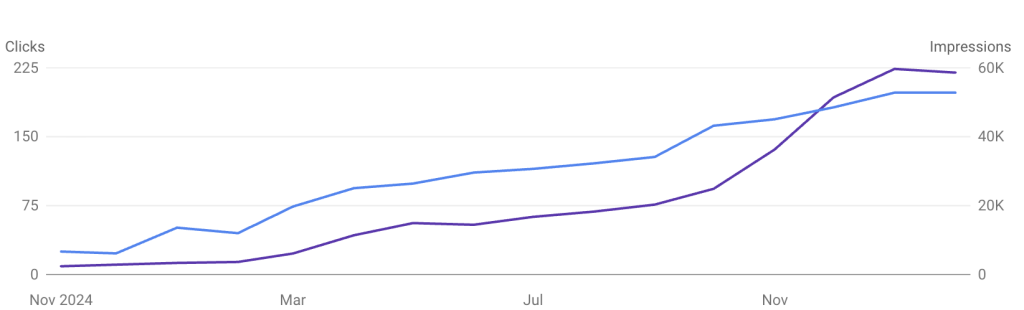
Had they stopped working on SEO with us in month three, they may have seen an upward trajectory for a month or two, but their website would likely have flatlined just as soon as it was gaining momentum.
Tip: looking for a more granular look at when to use SEO or paid ads? Check out our guide on exactly that: SEO vs Google Ads.
Our Recommendation for Indiana Businesses
SEO is a powerful marketing tool no matter where your business is, but there are a few things that are different in Indiana:
- Local competition is moderate. You’re usually not competing with national brands for most terms. Regional businesses in Tippecanoe County and across the state can dominate search with consistent effort.
- Regional understanding gives you an advantage. National SEO agencies don’t understand the nuances of the Indiana market, but we do. Hustlefish has done work with nonprofits in Indianapolis, businesses in Lafayette, and everything in between.
- More qualified leads. While overall search volume may be lower here than in bigger markets, SEO leads are more qualified. Indiana customers actively search for nearby solutions to their problems, making location-specific queries highly valuable.
Ready to explore whether SEO makes sense for your business? Let’s talk through your timeline, budget, and goals.
Frequently Asked Questions
Is SEO still worth it?
Yes — but the strategy has evolved. AI Overviews and tools like ChatGPT have changed how some people find information, but Google still processes billions of searches every day and organic traffic remains one of the highest-converting channels for most businesses. The businesses winning at SEO right now are the ones building authoritative, well-structured content, not chasing shortcuts.
Is SEO worth it with AI search changing everything?
SEO and AI search aren’t opposites — they’re increasingly the same thing. Google’s AI Overviews pull from pages that already rank well. ChatGPT and Perplexity cite authoritative sources. If your site is well-optimized, you’re more likely to show up in both traditional search results and AI-generated answers, not less.
Are SEO services worth the money?
It depends on your timeline and expectations. SEO takes 3-6 months to show meaningful results and 6-12 months for significant traction. If you need leads next week, paid ads are a better fit. If you want a compounding source of qualified traffic that doesn’t disappear the moment you stop paying, SEO is worth the investment — provided you’re working with an agency that’s transparent about timelines and reporting.
Is SEO worth it for small businesses?
Often yes, especially for local businesses. Local SEO in particular can be highly cost-effective because you’re competing in a smaller pool. The key is targeting realistic keywords for your market size and having a strategy that matches your budget.
Is it worth having a blog for SEO with AI taking over search results?
Yes, but the approach matters more than ever. Blog content that just summarizes what’s already ranking won’t cut through. Content that adds original insight, answers specific questions your customers are asking, and demonstrates real expertise still earns rankings and AI citations. The bar is higher, but the opportunity is still there.